
Design a Key-Value Store
1. The problem
A key-value (KV) store is a database that holds pairs: a unique key
(e.g. "user:1042:cart") mapping to a value — an opaque blob (raw
bytes; the database never looks inside it). It's the simplest kind of
NoSQL database (non-relational: no tables-with-joins like SQL).
API — the only three operations:
  put(key, value)    write / overwrite
  get(key)           read
  delete(key)        remove
No joins, no secondary indexes (you can only look up by the key, never by the value), no multi-key transactions.
The trap: this is NOT the "design a cache" question.
  cache      a volatile (RAM-only, loseable) layer in FRONT of a database
             node dies → you lose speed, not data
  KV store   IS the system of record — the authoritative copy of the data
             node dies → you must NOT lose data
That one word — durability (a write, once acknowledged, survives crashes, disk failures, power loss) — drags in everything below: replication, quorums, conflict resolution, repair, and a real storage engine.
2. Requirements to clarify (first 5 min of the interview)
Functional requirements = what the system does (the API above). Non-functional requirements = how well it does it — and these drive the whole design. Ask:
- Read-heavy or write-heavy? (ratio of gets to puts)
- Key/value size limits? (typical: ≤1 MB; rare huge values → chunk + manifest, §14)
- Latency target? (p99 = the time the slowest 1% of requests take; "single-digit ms p99" = 99% of requests finish in under ~10 ms)
- During a network failure: keep serving (availability) or refuse rather than serve stale data (consistency)? → decides §3
Back-of-envelope estimate (rough math to justify the architecture):
  100M keys × 10 KB avg   = 1 TB of raw data
  × 3 copies (replication) = 3 TB
  + say 100k requests/sec (QPS = queries per second)
  → too big for one machine's RAM, too much traffic for one machine's NIC
  → must DISTRIBUTE across many servers
Mention the single-server version first (a hash table in RAM; compress values; spill cold data to disk) — then break it on capacity. Shows you don't reach for distributed complexity by default.
3. CAP theorem — the framing decision
CAP stands for the three properties a distributed data system might want:
- C — Consistency: every read returns the most recent write (all servers agree on the current value). Note: this is a different "C" from the C in ACID; here it means "everyone sees the same, latest data."
- A — Availability: every request gets a (non-error) response, always — even if some servers are down.
- P — Partition tolerance: the system keeps working when a network partition happens — i.e. the network breaks such that some servers can't talk to other servers (cables cut, switch dies, datacenter link drops). Both halves are alive but can't see each other.
The theorem: when a partition happens, you cannot have both C and A. Proof by intuition: server group 1 gets a write, but the link to group 2 is down. Group 2 now either (a) answers reads with its old value → available but inconsistent, or (b) refuses to answer until the link heals → consistent but unavailable. There is no third option.
Partitions WILL happen in any real network, so P is not optional. The real design choice is: what do we sacrifice DURING a partition — C or A?
| Choice | Behaviour in a partition | Good for | Real systems |
|---|---|---|---|
| AP | keep accepting reads & writes everywhere; copies may disagree temporarily; reconcile later | shopping carts, sessions, user profiles — where "always writable" beats "always exact" | Dynamo, Cassandra, Riak |
| CP | refuse / block requests rather than ever serve stale data | locks, configuration, leader election, bank-style counters | etcd, ZooKeeper, HBase |
AP systems give eventual consistency: if writes stop, all copies converge to the same value eventually (seconds, usually), but a read during the window may see an older value.
Say the choice out loud in the interview. The canonical answer to this question is the AP / Dynamo-style design (Dynamo = Amazon's 2007 paper that invented most of this machinery). Everything below builds it. If the interviewer demands strong consistency instead: pivot to one leader (single boss server) per shard + a consensus protocol (Raft/Paxos — algorithms by which servers vote to agree on one value) — know that at a sentence level.
The whole design = four decisions:
- where keys live → consistent hashing (§4)
- how many copies must answer → quorum: N, R, W (§5)
- who wins when two writes collide → vector clocks vs last-write-wins (§6)
- per-request consistency dial → tunable R/W (§5)
4. Partitioning — which server has key X?
Partitioning (= sharding): splitting the dataset across many servers because it doesn't fit on one. Done with consistent hashing: hash both keys and servers onto a circle (the ring); walking clockwise from a key's position, the first server you meet owns the key.
Full detail (why hash % N fails, arcs, adding/removing servers, virtual
nodes, membership) lives in the separate consistent-hashing notes — one
image as the anchor:
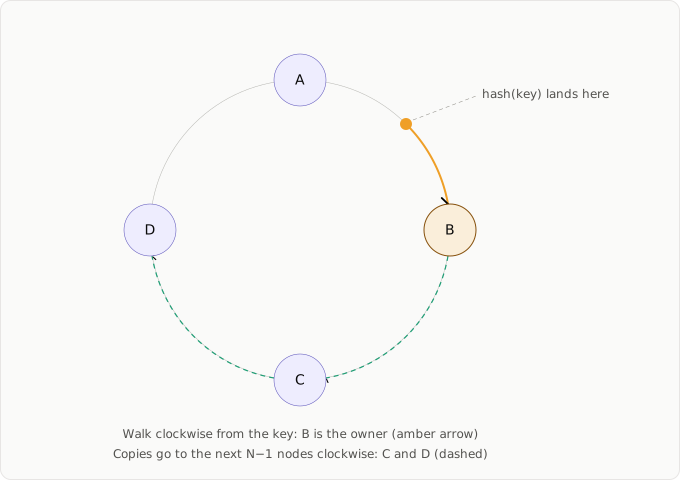
One-sentence version for THIS interview: "consistent hashing, so adding capacity moves only ~1/N of keys; virtual nodes (each physical server placed at many ring positions) for load balance; replicas = the next N−1 distinct physical machines clockwise, spread across racks."
5. Replication & quorums (the heart of the design)
Replication: keeping each key on several servers (replicas) so no single failure loses data. Each key lives on N replicas (typically N=3): the ring owner + the next N−1 distinct nodes clockwise.
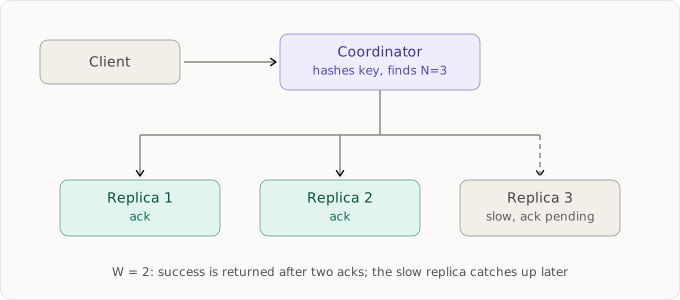
This design is leaderless: no single boss server per key — any replica can accept a read or write. (Contrast: leader-based replication, where one node takes all writes and followers copy it.) The node that happens to receive a client's request acts as the coordinator: it hashes the key, finds the N replicas, forwards the request to them, and collects answers.
The two knobs:
- W (write quorum) = how many of the N replicas must ack (acknowledge: "I durably stored it") before the coordinator tells the client "success"
- R (read quorum) = how many replicas must answer a read before the coordinator replies with the newest of their answers
The magic rule:
  R + W > N   →  the set of nodes that answered the read and the set that
                 stored the write MUST overlap on ≥1 node (pigeonhole)
→ every read touches at least one up-to-date copy| Config | You get |
|---|---|
| N=3, R=2, W=2 | the standard — overlap guaranteed, balanced latency |
| W=1, R=1 | fastest possible, but stale reads allowed (R+W ≤ N) |
| W=N | strongest write durability; one slow/dead replica blocks ALL writes |
| R=1, W=N or R=N, W=1 | make whichever path is hotter cheap |
Say the trade-off sentence: "R+W > N buys freshness but reduces availability (more nodes must be up); R+W ≤ N buys speed but allows stale reads." Choosing R and W per request = tunable consistency.
6. Conflicts & versioning
Because the system is leaderless AND always-writable, two servers can accept concurrent writes to the same key (neither knew about the other — e.g. during a partition, or two clients racing). Now the key has two versions. Someone must decide the winner:
| Strategy | How it works | Cost |
|---|---|---|
| Last-write-wins (LWW) | every write carries a timestamp; highest timestamp wins, other write is discarded (Cassandra's default) | clock skew — server clocks drift apart by ms–seconds, so "last" may actually be first → a legitimate write silently vanishes |
| Vector clocks | every version carries a list of (server, counter) pairs recording its edit history; system can detect that two versions are concurrent and keep both | the application must merge the two versions; long histories get truncated, losing causality info |
How to compare two vector clocks:
  X = [(A,2),(B,1)]     Y = [(A,3),(B,1)]
  every counter in X ≤ its counter in Y  →  X is an ANCESTOR of Y
                                            (Y already includes X) → drop X
  neither dominates the other            →  CONCURRENT → real conflict →
                                            keep both "siblings", let the
                                            reader merge (Dynamo's shopping
                                            cart: union of both carts)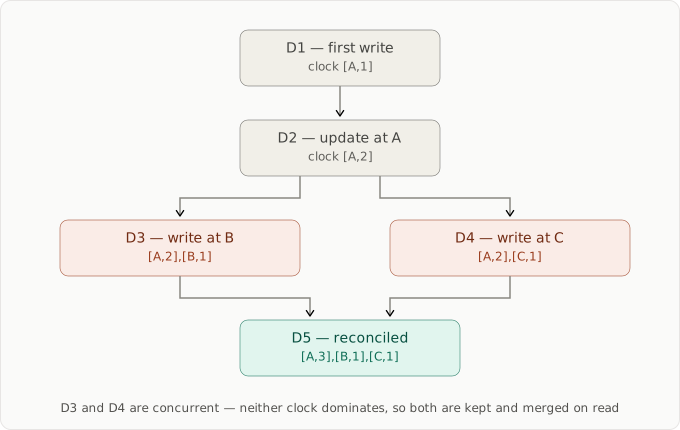
Senior move: pick per use case, out loud. Cart / user data → vector clocks or merge-friendly data. Metrics, "latest status" → LWW is fine, losing one overwrite is harmless.
7. Failure handling — detect, bridge, repair
Three beats, in this order. (A node = one server in the cluster.)
7.1 Detect — gossip protocol
Problem: how does anyone know a node died? A central health-checker would be a SPOF (single point of failure) and a bottleneck. Instead, gossip:
- every node keeps a membership table: for each peer, a heartbeat counter (a number the peer increments every second to prove it's alive) and when we last saw it increase
- every round (~1 s), each node increments its own counter and sends its whole table to a few random peers
- receivers merge: for each entry keep the higher counter
- a node whose counter hasn't risen past a timeout → marked down (locally)
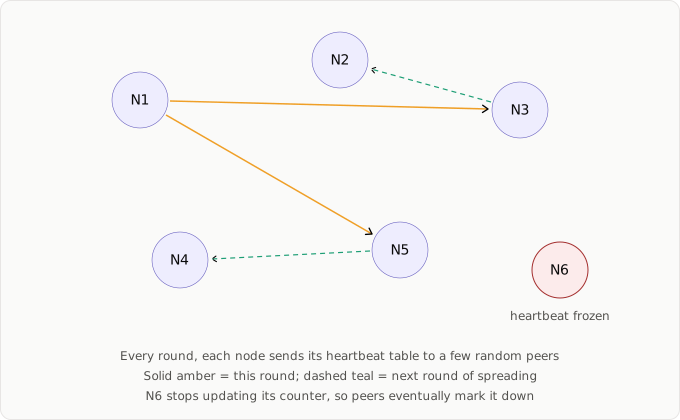
- News reaches all n nodes in ~log(n) rounds; each node sends O(1) msgs/round → scales with no central registry
- "Down" is a local, probabilistic opinion, not a global fact. Cassandra refines the fixed timeout with a phi-accrual detector (adapts the threshold to observed network jitter → fewer false alarms)
7.2 Bridge (temporary failure) — sloppy quorum + hinted handoff
A strict quorum requires W acks from the key's N home replicas — so if one is down, writes fail. Availability lost. Instead:
- Sloppy quorum: accept acks from the first N healthy nodes walking the ring — a substitute node may stand in for a down home replica
- Hinted handoff: the substitute stores the value plus a hint — a note saying "this really belongs to node C" — and when C recovers, the substitute delivers the data to C and deletes its own copy
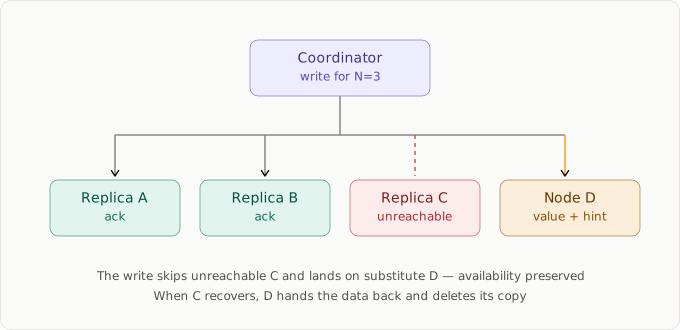
Risk to name: if the substitute ALSO dies before handoff, the hint (and possibly the write) is lost. And during a partition, sloppy quorums on the two sides can both "succeed" → more conflicts for §6 to resolve.
7.3 Repair (long-term divergence) — read repair + Merkle-tree anti-entropy
Replicas drift apart (missed writes, lost hints). Two fixes:
- Read repair: a read already touches R replicas; if one returned a stale version, the coordinator pushes the newest version back to it. Free-ish, but only heals keys that get read.
- Anti-entropy (background sweep for everything else, incl. cold keys): each replica builds a Merkle tree = a tree of hashes over its key ranges — leaves hash small ranges, each parent hashes its children, the root summarizes the whole dataset in one hash. Two replicas compare top-down: roots equal → identical, ZERO data moved; roots differ → compare children, descend only into differing branches → ship only the divergent range.
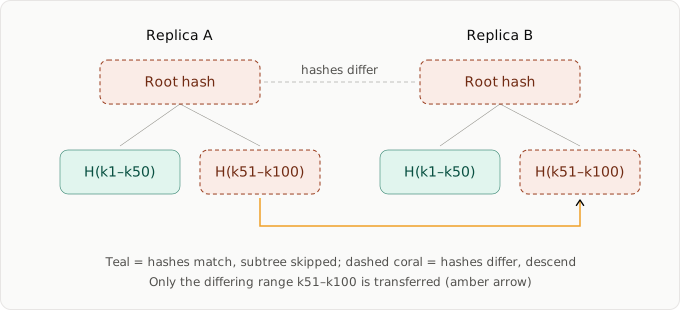
  cost of comparison  ~ log(#ranges) hash exchanges
  cost of transfer    ~ amount of DIVERGENCE, not dataset size
8. Storage engine — LSM tree (inside one node)
Storage engine = the code inside ONE server that puts bytes on disk and gets them back. Ours is an LSM tree = Log-Structured Merge tree: log-structured — never modify data in place, only append to logs; merge — tidy up by merging sorted files in the background. Used by Cassandra, RocksDB, LevelDB, HBase, BigTable.
Why it exists: disks are ~10× faster at sequential I/O (writing at the end of a file) than random I/O (jumping around updating bytes). B-trees — the classic engine under SQL databases — update pages in place = random I/O on every write. LSM appends only → huge write throughput.
8.1 Write path
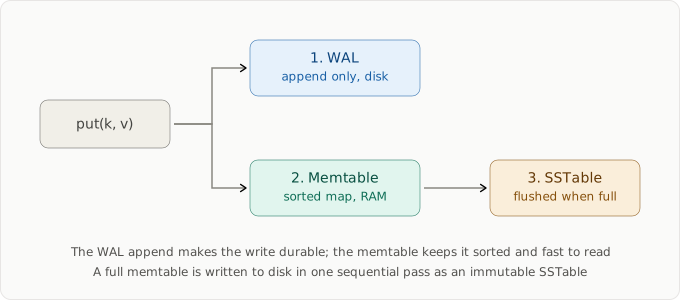
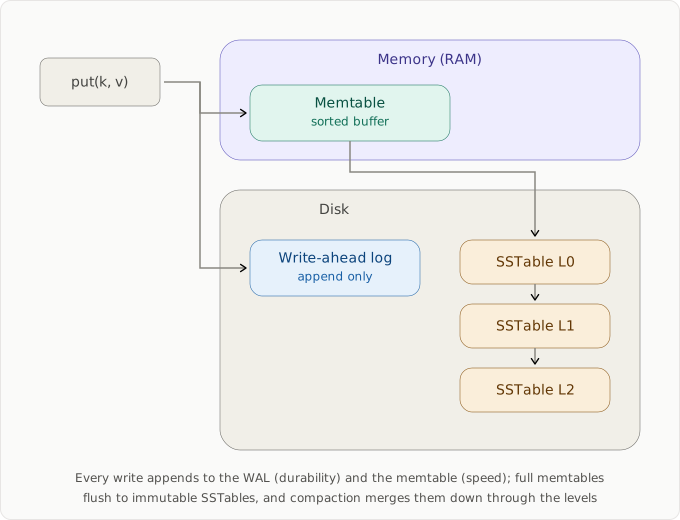
- Append to the WAL (write-ahead log) — an append-only file on disk. Pure insurance: never read in normal operation, only replayed after a crash to rebuild what RAM lost. This is the durability guarantee.
- Insert into the memtable — an in-memory sorted map (skip list or balanced tree). Sorted so it's fast to read and trivial to dump in order.
- Memtable hits its size threshold → frozen → written to disk in one sequential pass as an immutable SSTable; its WAL file is then deleted and a fresh memtable + WAL take over.
8.2 Inside an SSTable (Sorted String Table)
An SSTable = an immutable (write-once, never edited) file of key-value pairs sorted by key, plus two helper blocks:
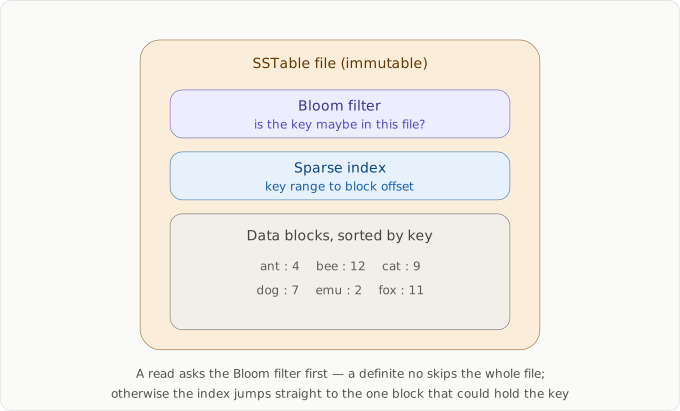
- Bloom filter: a tiny probabilistic bitmap answering "is key X in this file?" with either definitely no or maybe yes — false positives possible (~1%), false negatives never. Since a key lives in only a couple of the many SSTables, this lets reads skip almost every file without touching disk.
- Sparse index: every Nth key → byte offset of its block, so a lookup jumps straight to one block instead of scanning the file.
- Sortedness is the superpower: binary search within a file, and two sorted files merge in ONE linear pass (like merging two sorted card decks).
8.3 Reads, deletes, compaction
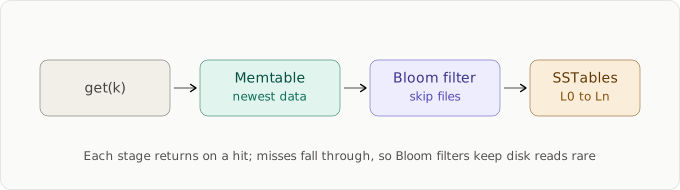
- Read: memtable first, then SSTables newest → oldest (each gated by its Bloom filter). Newest-first is also why updates work: an update just writes the key again; the fresh copy is met before the stale one.
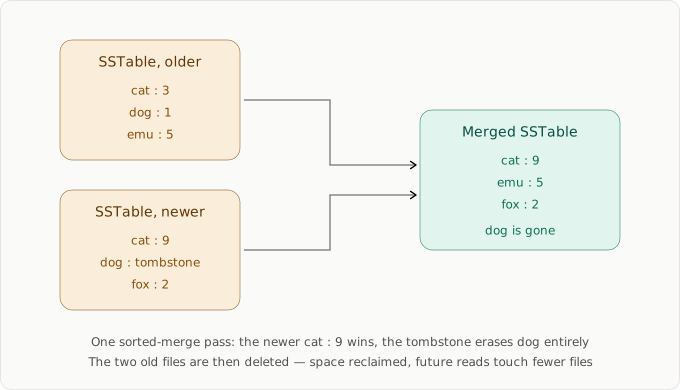
- Delete: files are immutable, so you can't erase — instead write a tombstone (a special "this key is deleted" marker). Reads that meet a tombstone answer "not found". The key + tombstone are physically removed later, at compaction. Tombstones must survive a GC grace period (longer than the repair interval) — otherwise a replica that never heard about the delete will "resurrect" the key during repair.
- Compaction: the background merge — take SSTables with overlapping key ranges, merge-sort them into new files: newest value per key wins, values shadowed by tombstones are dropped, old files deleted. Keeps the file count (and read cost) bounded and reclaims space.
8.4 The three amplifications (name the costs — the senior bit)
| Amplification | Meaning |
|---|---|
| Write | compaction rewrites the same data several times as it migrates down levels (L0→L1→L2…) — you pay background disk work for fast ingestion |
| Read | a key may live in several files, so a get can touch several (Bloom filters + block caches mitigate) |
| Space | stale versions + tombstones linger until compaction claims them |
Soundbite: "LSM trades read and space amplification for sequential-write throughput; B-trees make the opposite trade."
9. End-to-end paths (narrate these in the interview)
  WRITE
  client ─► any node (becomes coordinator)
         ─► hash key onto ring → find the N replicas → stamp vector clock
         ─► send to N; each replica: WAL append → memtable insert → ack
         ─► W acks collected → tell client "success"
            (home replica down? → sloppy quorum: substitute takes it with a hint)

  READ
  client ─► coordinator ─► ask the N replicas, wait for R answers
         ─► all versions equal → return it
         ─► versions diverge → vector-clock compare → drop ancestors,
            return/merge concurrent siblings, READ-REPAIR the stale replica
         ─► inside each replica: memtable → Bloom filters → SSTables (newest first)
One-line system summary: a leaderless ring of identical LSM-backed nodes; keys placed and replicated N-ways by consistent hashing; quorums give tunable consistency; gossip + hinted handoff + Merkle repair give fault tolerance.
10. The Dynamo cheat table (memorise)
| Problem | Technique | Why it wins |
|---|---|---|
| Partitioning | consistent hashing + vnodes | adding capacity moves ~1/N of keys |
| Write availability | vector clocks, reconcile on read | never refuse a write |
| Temporary failures | sloppy quorum + hinted handoff | writes succeed while replicas are down |
| Permanent failures | anti-entropy via Merkle trees | background sync, ship only the diff |
| Membership & detection | gossip | no central registry, no SPOF |
11. Interview script
  1. clarify         sizes, read/write mix, latency target, C-vs-A in a partition
  2. estimate        ~TBs, ~100k QPS → one box can't → distribute
  3. single server   hash table in RAM — then break it on capacity
  4. CAP call        "partitions happen; I'll go AP, Dynamo-style" — out loud
  5. partition       ring + vnodes (one sentence, point at CH notes)
  6. replicate       N=3 across racks; quorum R/W; the R+W>N overlap rule
  7. conflicts       LWW vs vector clocks — pick FOR the use case      ← unprompted
  8. failures        detect (gossip) / bridge (hints) / repair (Merkle) ← unprompted
  9. storage         LSM: WAL → memtable → SSTable → compaction; Bloom filters
 10. walk the paths  write end-to-end, then read; kill a node mid-walk yourself
Steps 7, 8 and the amplification costs in 9 separate a pass from a strong pass.
12. The lines that earn the most
- "This is a system of record, not a cache — durability is what forces replication, quorums and a real storage engine."
- "R + W > N guarantees the read overlaps the write on at least one node; below that I'm choosing latency over freshness — and I can dial it per request."
- "LWW is simple but clock skew silently loses writes; vector clocks detect concurrency but push the merge to the app — I'd pick per use case."
- "A failed node must not change the ring — gossip detects, hinted handoff bridges, Merkle-tree anti-entropy repairs."
- "LSM trades read and space amplification for sequential-write throughput; and tombstones need a GC grace period or deleted keys resurrect."
13. Numbers to remember
| Thing | Value |
|---|---|
| Typical replication | N=3, R=2, W=2 |
| Sequential vs random disk I/O | ~10× faster |
| Gossip spread | ~log(n) rounds; O(1) msgs/node/round |
| Typical value limit | ≤1 MB (larger → chunk + manifest) |
| Bloom filter | ~1% false positives at ~10 bits/key; false negatives: never |
| Merkle comparison | log(#ranges) exchanges; transfer ∝ divergence |
| Dynamo paper | 2007, Amazon — source of the whole cheat table |
14. Common follow-ups
| Follow-up | Answer skeleton |
|---|---|
| Hot key / skew (one viral key hammers a node) | salt the key (append a random suffix to spread it), request-level cache, split the hot range |
| 2 GB values | split into chunks under derived keys (k#0, k#1…) + a manifest object listing them |
| Deleted keys coming back | tombstone GC grace period must exceed the repair interval |
| "I need strong consistency" | pivot: leader per shard + Raft/Paxos consensus |
| Range scans ("all keys from A to B") | LSM files are sorted → per-node scans easy; a hash ring scatters the range across nodes — say the tension |
15. When NOT to go deep
Product design interview ("design WhatsApp") → one sentence and move on:
"User/session state goes in a Dynamo-style KV store — replicated 3-way with quorum reads/writes, so it survives node failures without a leader."
Go deep only when the question IS the store: this question, distributed cache, message-broker storage, or "design DynamoDB / Cassandra" by name.
16. Glossary (A–Z, one line each)
| Term | Meaning |
|---|---|
| ack | acknowledgement — a replica's "I durably stored it" reply |
| anti-entropy | background process syncing replicas that drifted apart (via Merkle trees) |
| AP / CP | the two CAP stances: available-during-partition vs consistent-during-partition |
| availability | every request gets a non-error response, even with servers down |
| B-tree | update-in-place storage structure (SQL default); read-optimised, random-I/O writes |
| blob | binary large object — raw bytes the DB doesn't interpret |
| Bloom filter | tiny bitmap answering "key in this file?" — definite no / maybe yes; never a false no |
| CAP theorem | during a network partition you can keep Consistency or Availability, not both |
| clock skew | server clocks drifting apart — why LWW timestamps can pick the wrong winner |
| compaction | background merge of SSTables: newest value wins, tombstoned data dropped, space reclaimed |
| concurrent writes | two writes to the same key where neither knew of the other |
| consensus (Raft/Paxos) | protocols by which servers vote to agree on one value/leader (CP world) |
| consistency (CAP sense) | every read sees the most recent write |
| consistent hashing | keys and servers hashed onto a ring; clockwise walk finds the owner; resizing moves ~1/N keys |
| coordinator | whichever node received the client's request; hashes the key, fans out to replicas, collects answers |
| durability | an acknowledged write survives crashes and restarts |
| eventual consistency | stop writing and all replicas converge; reads meanwhile may be stale |
| gossip | peers exchange membership/heartbeat tables with random peers each round; news spreads epidemically |
| GC grace period | how long tombstones are kept so every replica hears about a delete before it's purged |
| heartbeat counter | number a node increments to prove liveness; frozen counter → node presumed down |
| hinted handoff | substitute node stores a write + a note of the real owner, delivers it when the owner recovers |
| leaderless | no boss node per key; any replica accepts reads/writes (Dynamo style) |
| LSM tree | Log-Structured Merge tree — append-only writes + background merging; write-optimised engine |
| LWW | last-write-wins — highest timestamp wins a conflict; simple, can silently lose writes |
| memtable | in-memory sorted map buffering recent writes until flushed |
| Merkle tree | tree of hashes over key ranges; compare roots→leaves to find divergence cheaply |
| N / R / W | copies per key / replicas that must answer a read / replicas that must ack a write |
| node | one server in the cluster |
| NoSQL | non-relational databases (KV, document, column, graph) |
| p99 | 99th-percentile latency — how slow the worst 1% of requests are |
| partition (data) | a shard — one slice of the dataset living on one server |
| partition (network) | network failure splitting the cluster into groups that can't talk to each other |
| phi-accrual detector | adaptive failure detector: learns normal heartbeat jitter, outputs suspicion level, fewer false alarms |
| QPS | queries per second |
| quorum | minimum number of replicas that must participate for an operation to count |
| read repair | during a read, push the newest version to any replica that answered with a stale one |
| replica / replication | a copy of the data / keeping N copies on different machines & racks |
| ring | the circular hash space of consistent hashing |
| sequential vs random I/O | writing at the end of a file vs jumping around; sequential is ~10× faster |
| shard | see partition (data) |
| sloppy quorum | count acks from the first N healthy nodes, substitutes allowed — availability over strictness |
| SPOF | single point of failure |
| SSTable | Sorted String Table — immutable on-disk file of key-sorted pairs + Bloom filter + sparse index |
| strict quorum | acks must come from the key's N home replicas only |
| system of record | the authoritative copy of the data (unlike a cache) |
| tombstone | a "deleted" marker written in place of erasing; purged at compaction after the grace period |
| tunable consistency | choosing R and W per request to trade freshness vs latency/availability |
| vector clock | per-version list of (server, counter) pairs; detects whether versions are ordered or concurrent |
| virtual node (vnode) | one of many ring positions a physical server occupies, for load balance |
| WAL | write-ahead log — append-only durability log, replayed after a crash, deleted after flush |