
Design a Unique ID Generator in Distributed Systems
1. The problem
Generate IDs that are globally unique across many servers, fast, with no central bottleneck.
On ONE server it's trivial: a database auto_increment column (the DB hands out 1, 2, 3, …; its transaction handling stops two simultaneous requests from getting the same number). At scale it breaks:
  server 1:  1, 2, 3, ...        two servers counting independently
  server 2:  1, 2, 3, ...   →    collide on the very first ID
And funnelling every write through one counting server = a bottleneck + a SPOF (single point of failure). That's the whole puzzle.
Where it's used: primary keys for tweets/orders/messages, URL-shortener IDs (chapter 8 imports this one), tracing IDs — any write-heavy distributed system.
2. Requirements (extract these from the interviewer)
The book's clarified list:
| Question to ask | Book's answer |
|---|---|
| Unique? | yes, globally |
| Format? | numeric only |
| Length? | fits in 64 bits |
| Increment by +1? | no — ordered by time (k-sortable) |
| Scale? | 10,000 IDs/sec, low latency, highly available |
Two terms to know cold:
- Why 64-bit numeric: fits a standard
bigintcolumn; small on the wire; keeps B-tree indexes fast (the tree structure databases use for primary keys — it stays cheap when new keys land at the end, i.e. keys increase). - K-sortable: roughly ordered by creation time — newer IDs are usually bigger, occasional slight out-of-order is fine. "Roughly" matters: perfect global ordering needs coordination; rough ordering is free.
3. The four approaches (walk them in this order, reject with reasons)
3.1 Multi-master replication — auto_increment by k
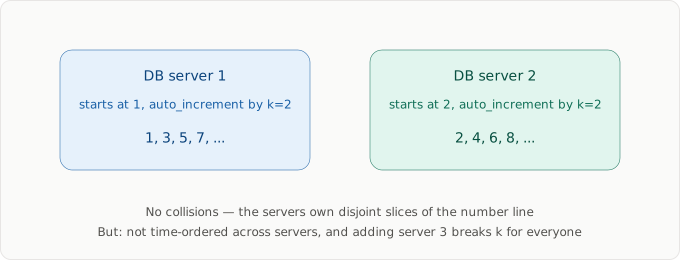
Keep DB auto_increment, but each of the k servers increments by k, starting at a different offset → disjoint slices of the number line:
Rejected because:
- Not time-ordered across servers — a busy server races ahead on the number line while an idle one lags, so ID order ≠ creation order
- Adding/removing a server changes k → every server must be reconfigured — complex and error-prone
- OK only for small, static clusters
3.2 UUID
UUID (Universally Unique Identifier): a 128-bit identifier, standardized
by RFC 4122, generated locally from randomness — format
550e8400-e29b-41d4-a716-446655440000. Collision odds are astronomically
small (treated as impossible in practice).
Pros: dead simple; no network call; no coordination of any kind.
Rejected for THESE requirements:
- 128 bits (need 64), alphanumeric (need numeric)
- Not time-sortable → random keys thrash B-tree indexes (inserts land all over the tree instead of at the end)
Modern bonus point (post-book, say it): UUIDv7 is a standardized time-ordered UUID — the best choice when 128 bits is acceptable. ULID is similar (128-bit, sortable, compact Base32 string). Knowing when the 64-bit-numeric constraint actually matters vs "just use UUIDv7" is the judgment interviewers probe.
3.3 Ticket server
One central service (a DB with auto_increment) that everyone calls for the next number. Popularized by Flickr.
Pros: unique, numeric, roughly sequential; very simple.
Rejected because:
- The central server is a SPOF
- Making it redundant (multiple ticket servers) reintroduces the synchronization problems of 3.1
- Every single ID costs a network round trip → caps throughput, adds latency to every write in the company
3.4 Twitter Snowflake — the answer
Divide and conquer: build uniqueness INTO the ID by packing three facts into 64 bits — WHEN it was made, WHERE it was made, WHICH one it was within that instant. Every node generates independently: no network call, no runtime coordination.
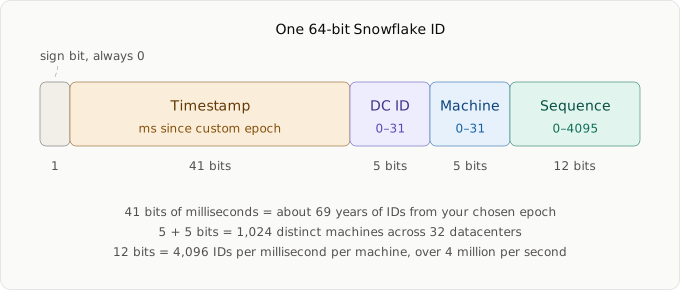
| Field | Bits | Meaning |
|---|---|---|
| Sign | 1 | always 0 → ID stays a positive signed int |
| Timestamp | 41 | milliseconds since a custom epoch |
| Datacenter ID | 5 | which building (0–31) |
| Machine ID | 5 | which box in it (0–31) |
| Sequence | 12 | counter within one ms on one machine (0–4095) |
Why each field is shaped that way:
- Timestamp in the MOST significant (leftmost) bits → sorting IDs numerically sorts them by time. That's where k-sortability comes from, free.
- Custom epoch = the zero-point the clock counts from. Not Unix's 1970-01-01 but e.g. your launch date → your 41 bits (~69 years of ms) run out ~2090 instead of ~2039.
- DC + machine bits are assigned once at startup (config, a coordination service, or derived from the pod's IP). The ONLY coordination in the design — and it's at boot, not per ID. Two live machines must never share a pair.
- Sequence = tiebreaker for same-millisecond IDs on one machine, behind a local mutex:
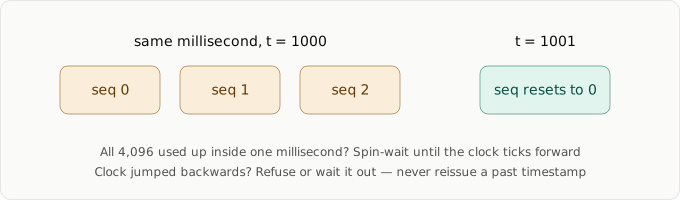
  same ms again?        sequence++          (up to 4096 per ms)
  sequence exhausted?   spin-wait until the clock ticks to the next ms
  new ms?               sequence = 0
Uniqueness by construction: a collision needs same ms AND same DC AND same machine AND same sequence — the counter makes that impossible on a correctly configured machine.
Capacity math: 4,096 IDs/ms/machine ≈ 4M+/sec/machine × 1,024 machines. The 10k/sec requirement is nothing.
4. Wrap-up issues (where seniors score)
4.1 Clock synchronization
The design assumes machines roughly agree on time. Reality:
- All nodes run NTP (Network Time Protocol — daemons that keep server clocks accurate to within a few ms of true time).
- Skew between machines (A's clock ≠ B's clock): harmless for uniqueness — each machine's IDs carry its own machine bits, so cross-machine collisions can't happen. Only effect: slight cross-machine ordering fuzz (hence k-sortable, not sortable).
- The dangerous case — one clock stepping BACKWARDS (e.g. an NTP
correction): the machine could revisit a (timestamp, sequence) pair it
already issued → duplicates. Defenses:
- remember the last timestamp issued; if
now < last, refuse or wait — never reissue a past timestamp - configure NTP to smear (slow the clock gradually) instead of stepping
- remember the last timestamp issued; if
4.2 Section-length (bit-budget) tuning
41/5/5/12 is a default, not a law:
| Situation | Move |
|---|---|
| Few machines, insane burst rates | shrink machine bits → grow sequence |
| Low concurrency, system must outlive you | grow timestamp bits |
| One datacenter only | fold DC bits into machine ID (10-bit machine) |
Saying "the split is a tunable budget" shows understanding, not memorization.
4.3 High availability
Everything depends on the generator → it must be always-on. Good news: the design is naturally HA — every node is independent, run many, clients fail over to any other. Remaining operational risks are the coordinated parts:
- machine-ID assignment — two nodes sharing an ID = collisions
- clock health — see 4.1
Common deployment: a sidecar — the generator runs next to the application process, called over a zero-latency local interface, worker ID derived statelessly (e.g. from pod IP) to avoid a ZooKeeper dependency.
5. Interview script
  1. clarify      unique? numeric? 64-bit? time-sortable? IDs/sec (10k)?
  2. single box   auto_increment — then break it: 2 servers → instant collision
  3. multi-master increment by k → not time-ordered, resizing reconfigures all
  4. UUID         local & simple → 128 bits, random order thrashes B-trees
                  (+ "UUIDv7 fixes ordering" — modern bonus)                ← unprompted
  5. ticket srv   central counter → SPOF + network hop per ID
  6. snowflake    time + place + count in 64 bits; DRAW the bit layout
  7. deep dive    custom epoch (~69 yrs), sequence spin-wait, boot-time machine ID
  8. wrap-up      NTP + clock-backwards defense, bit tuning, HA / sidecar   ← unprompted
6. The lines that earn the most
- "The timestamp sits in the most significant bits, so numeric order IS time order — sortability costs nothing."
- "The only coordination is machine-ID assignment at boot — generation itself is a local counter behind a mutex. No network, no bottleneck."
- "Skew between machines can't cause duplicates — machine bits differ. A clock stepping backwards on one machine can — so I track the last timestamp issued and refuse to go back, and I smear NTP corrections."
- "The 41/5/5/12 split is a tunable bit budget, not a constant."
- "If 64-bit numeric weren't a requirement, UUIDv7 gets the same time-ordering as a ratified standard with zero infrastructure."
7. Numbers to remember
| Thing | Value |
|---|---|
| Snowflake size | 64 bits: 1 + 41 + 5 + 5 + 12 |
| Timestamp span | 2^41 ms ≈ 69 years from the custom epoch |
| Machines | 2^(5+5) = 1,024 (32 DCs × 32 machines) |
| Sequence | 2^12 = 4,096 IDs per ms per machine ≈ 4M+/sec |
| Book's requirement | 10,000 IDs/sec |
| UUID size | 128 bits |
| NTP accuracy | within a few milliseconds |
8. Common follow-ups
| Follow-up | Answer skeleton |
|---|---|
| Clock goes backwards | last-timestamp guard: refuse/wait; NTP smearing |
| 4,096/ms exhausted | spin-wait for the next millisecond (microseconds of stall) |
| How are machine IDs assigned | config / coordination service at boot / stateless from pod IP; must be unique among LIVE nodes |
| IDs leak information | yes — timestamp & volume are recoverable from an ID; don't use as a security token |
| Need strict global ordering | Snowflake can't (k-sortable only) → central sequencer or logical clocks — different problem |
| 128 bits acceptable? | UUIDv7 / ULID — standardized, sortable, no infra |
9. When NOT to go deep
In a product design interview ("design Twitter / URL shortener"), one sentence and move on:
"IDs come from a Snowflake-style generator — 64-bit, time-sortable, generated locally on each node, so there's no central bottleneck."
Go deep only when the question IS the generator (this chapter), or when the interviewer pushes on ID collisions / ordering in another design.
10. Glossary (A–Z, one line each)
| Term | Meaning |
|---|---|
| auto_increment | DB column feature: each insert gets the previous number + 1, uniqueness handled by the DB's transactions |
| B-tree index | the tree structure databases use for keys; fast when inserts land at the end (increasing keys), thrashed by random keys |
| bigint | standard 64-bit integer column type — why "fits in 64 bits" matters |
| clock skew | different machines' clocks disagreeing by ms–seconds |
| clock smearing | correcting a clock gradually (slowing it) instead of jumping it, so time never goes backwards |
| coordination | machines having to talk/agree before acting — the thing Snowflake removes from the per-ID path |
| custom epoch | a chosen zero-date for the timestamp (e.g. launch day) to spend the 69-year budget wisely |
| epoch | the zero-point a timestamp counts from (Unix epoch = 1970-01-01) |
| k-sortable | roughly ordered by creation time; slight out-of-order allowed |
| machine ID / worker ID | the bits identifying which server generated the ID; assigned once at boot, must be unique among live nodes |
| most significant bits | the leftmost bits of a number — biggest place value; timestamp lives here so numeric order = time order |
| multi-master replication | several DBs each generating IDs via auto_increment by k with different offsets |
| mutex | a lock ensuring one thread at a time updates the (timestamp, sequence) state |
| NTP | Network Time Protocol — keeps server clocks within a few ms of true time |
| sequence number | per-machine counter (0–4095) separating IDs born in the same millisecond |
| sidecar | deployment pattern: the generator runs beside the app process, called locally with zero network latency |
| sign bit | top bit of a signed integer (1 = negative); kept 0 so IDs stay positive |
| Snowflake | Twitter's 64-bit scheme: timestamp + datacenter + machine + sequence |
| SPOF | single point of failure |
| spin-wait | busy-loop until a condition holds (here: until the clock reaches the next ms) |
| ticket server | one central counter service everyone calls for the next ID |
| ULID | 128-bit sortable ID rendered as a 26-char Base32 string |
| UUID | 128-bit identifier generated from randomness (RFC 4122); v4 = random, unsorted |
| UUIDv7 | modern standardized UUID with a leading timestamp → time-ordered; best pick when 128 bits is fine |