
Design a Notification System
1. The problem
Turn "something happened to user 42" into a message arriving on one of user 42's devices, through a channel they agreed to, once, even when everything in between is flaky. Channels: mobile push (iOS, Android), SMS, email (often also in-app / web push).
Three properties make it a distributed system instead of a send() helper:
- Downstream of everyone. Every service is a producer. A retry-loop bug in the order service becomes our volume problem → idempotency and rate limiting are this system's responsibility, not the callers'.
- Upstream of nobody we control. Every channel terminates at a third party (APNs, FCM, Twilio, SES) with its own rate limits, error codes and outages.
- Trust cost per mistake. A duplicate OTP or a 3 a.m. promo is user-visible in a way a duplicated log line never is.
The trap: this is NOT "design a chat system." Nothing is bidirectional or connection-oriented. It is a fan-out and dispatch pipeline with reliability guarantees. Say so early.
2. Requirements (extract these)
| Question | Scoped answer (book) | Why it matters |
|---|---|---|
| Channels? | push (iOS + Android), SMS, email | each = different gateway, payload, errors |
| Real-time? | soft real-time — small delay under load OK | licenses the whole queue design |
| Triggers? | client apps and server-side schedulers | input is bursty by design |
| Opt-out? | yes | settings table, checked at the right time (§8) |
| Volume? | 10M push, 1M SMS, 5M email / day | avg is trivial; bursts are not |
Senior questions to ask unprompted:
- Priority classes? An OTP and a "you might like…" cannot share a queue.
- Delivery semantics? Queues are at-least-once; "exactly once" must be manufactured with dedup — and it has a residual gap (§6.2).
- What counts as success? Sent (gateway accepted) ≠ delivered (receipt confirmed). Push never confirms; SMS/email do, via webhooks.
- Expiry? A promo for a sale that ended is worse than nothing → per-message TTL.
3. Estimation
  16M/day ÷ 10⁵ s                     ≈ 160/sec average   → trivial, one box
  marketing blast 10M users in 1 hour  ≈ 3,000/sec         → 20× average, past provider limits
  → design point: bursts of 10³–10⁴/sec, NOT the average

  notification log: 16M/day × ~1 KB   ≈ 16 GB/day ≈ 6 TB/yr → time-partitioned store, 90-day TTL
  device tokens: 100M users × 2 × 200 B ≈ 40 GB            → fits a cache cluster
Thesis (say it): steady-state load is trivial; the architecture exists to absorb bursts and survive third parties. Every box is justified by one of those two.
4. The channels — what physically delivers
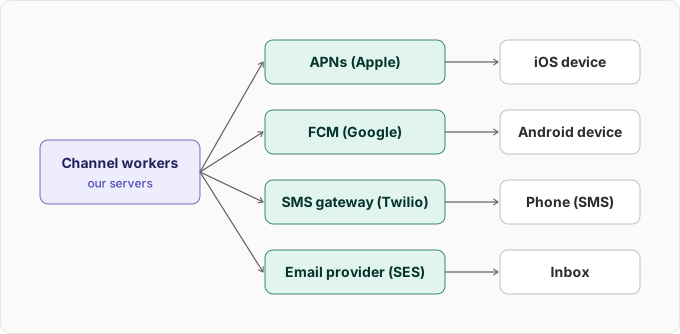
Your servers never touch the device. Every channel ends at a gateway you don't own.
iOS push — APNs (Apple Push Notification service)
The only path to an iPhone. Apple holds one persistent encrypted connection per device; only Apple can ring the doorbell. Three-party handshake:
- App registers → APNs issues a device token (opaque; means "this app on this device" — a capability, not a serial number).
- App posts the token to your backend (
POST /devices) → stored against the user. - To send: HTTPS/2 request to APNs with token + small JSON payload (
aps: alert, badge, sound, custom keys) + a JWT signed with your.p8key (token-based auth). Payload limit 4 KB (2 KB on the old certificate-based path). Rich content → put an ID in the push, let the app fetch.
Android push — FCM (Firebase Cloud Messaging)
Same shape. Say the 2026-correct version: the legacy HTTP/XMPP APIs were shut down (June 2024); the HTTP v1 API authenticates with OAuth 2.0 service-account tokens, not a static server key. Payload 4 KB. Error codes drive worker logic directly:
| Code | Meaning | Worker action |
|---|---|---|
404 UNREGISTERED | token dead (uninstall / rotated) | drop, delete device row, never retry |
429 QUOTA_EXCEEDED | rate limited | backoff + jitter, honour Retry-After |
503 UNAVAILABLE / 500 | provider trouble | backoff; circuit-break if widespread |
SMS / email — gateways
Twilio / SNS; SES / SendGrid. Don't run SMTP (deliverability, SPF/DKIM, reputation is a full-time job). They report asynchronously via webhooks (delivered / bounced / complained) — no webhook endpoint = you never learn what arrived. SMS is 160 chars GSM-7 / 70 chars UCS-2 per segment.
What this teaches: every channel has a stored address, its own payload format, its own error set, its own gateway with its own limits → one worker pool per channel (§5). Tokens rot → provider "dead token" errors are an instruction to delete; retrying them burns quota on ghosts.
5. High-level design
5.1 Contact-info gathering
Client registers on login through the LB → API servers → user DB.
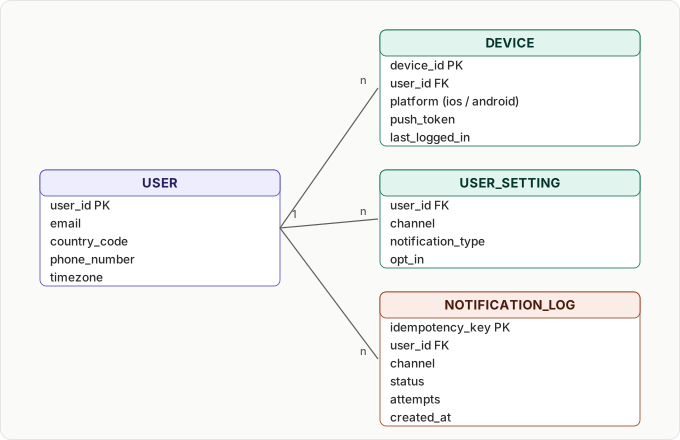
- One user, many devices → fan-out is per device (≈2 per user).
last_logged_in+ providerUNREGISTERED= how you prune.- The log's PK is the idempotency key, not an auto-increment — that's what makes dedup a single insert-if-absent (§6.2).
5.2 Naive design — one synchronous server — break it out loud
| Break | Why |
|---|---|
| Caller inherits provider latency | APNs slow → checkout slow. A side effect degraded the core action |
| No retry, no memory | 503 → notification evaporates; caller has already committed |
| The skyscraper | 10M campaign sends arrive as 10M sync calls → falls over, all lost |
| SPOF | one box |
Common cause: the caller's request and the provider's work are welded together. One idea fixes all four:
The API accepts the job. It does not do the job. Validate, record, enqueue,
202in milliseconds. Workers drain at the providers' pace.
5.3 The queue-decoupled design
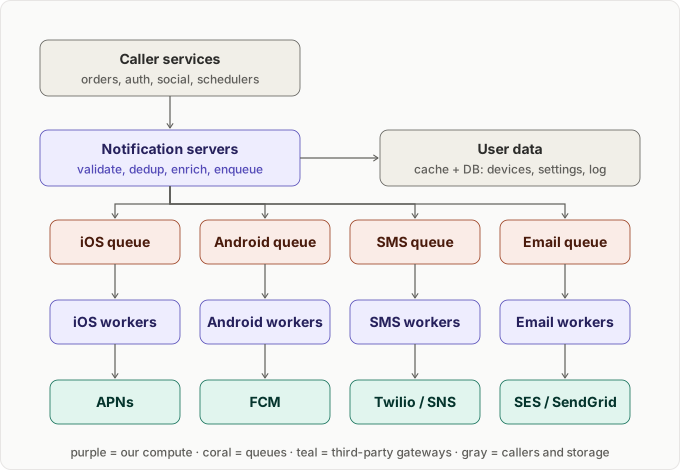
Notification servers — stateless, behind LB. POST /v1/notifications {idempotency_key, user_id | audience, type, channels[], params, priority, ttl}. In order:
- Authenticate + rate-limit the caller (appKey/secret, per-caller limit — the funnel protecting itself from what's above it).
- Idempotency check — insert-if-absent into the log; exists → return existing status, stop.
- Enrich — devices, email, timezone, settings from cache (DB on miss).
- Persist — one log row per (device, channel),
status = queued. - Enqueue one message per (device, channel) →
202 {notification_id}.
Never talks to a provider.
Cache + DB — users/devices/settings: small, relational (Postgres). The log is append-heavy, 16M rows/day, queried by ID and time → wide-column or time-partitioned table with TTL. Say the tension ("one Postgres table" = 6 TB in a year).
Queues — one per channel. Isolation by queue: APNs down for an hour → the iOS queue backs up (that's its job); Android/SMS/email don't notice. Blast radius of a provider outage = exactly one queue. Kafka if you need replay + partition ordering; RabbitMQ/SQS for native delay + dead-lettering. Name what you're buying.
Workers — one pool per channel. Each speaks one gateway's protocol and error dialect. Autoscale on queue depth and oldest-message age, never on API request rate (the API is fast no matter what).
One-liner: "Callers POST to stateless servers that dedup, enrich and persist, then fan out to one queue per channel; per-channel workers drain them into APNs/FCM/SMS/email with retries and provider-aware rate limiting."
6. Deep dive: reliability (where the interview is decided)
6.1 "Can a notification be lost?"
Trace where the message lives: caller memory → API memory → log → queue → worker memory → provider. Only the two "memory" spots can lose it.
- API crashes before writing the log → caller gets no 202 → caller retries (same idempotency key).
- Worker crashes before acking → queue redelivers to another worker.
Rule: persist before you acknowledge; acknowledge only after the work is
logged. The remaining gap — log row written, crash before enqueue — is
closed by a reaper (sweep stale queued rows) or, more principled, a
transactional outbox: log row + outbox row in one DB transaction; a relay
publishes outbox rows to the queue and can crash/restart freely.
6.2 "Can a user get it twice?" — yes; make the second harmless
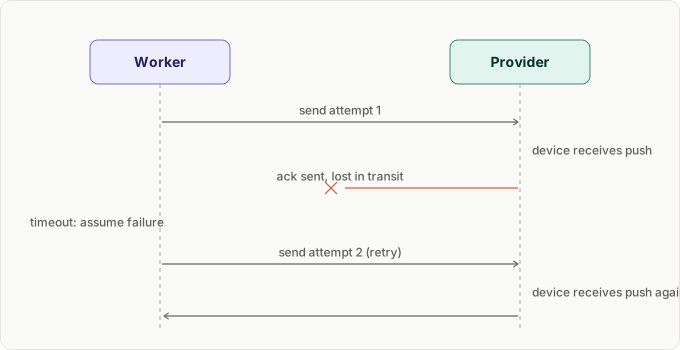
Nothing in that timeline is broken. The worker cannot distinguish "provider never got it" from "provider got it, ack died" — the ambiguous timeout — so retrying is correct, and the user gets two OTPs. Exactly-once delivery across a network is impossible. Duplicates enter at three layers:
- Caller retries after a lost 202.
- Queue redelivers after a worker crash mid-send (at-least-once).
- Worker retries after a lost provider ack.
One mechanism for all three: a key that identifies the logical event + a store that remembers keys.
- Caller-supplied key derived from the event, never the request:
order-987-shipped. A fresh UUID per request makes retries look new → defenceless. This is why the API requires the key: only the caller knows which requests are the same event. - Boundary check: insert-if-absent on the log (PK = key).
- Dispatch check in the worker:
SET dispatch:{id}:{device}:{channel} NX EX 86400before the provider call; mark "done" after success.
The honest sentence (say it unprompted): the worker marks after the
provider says OK; a crash in that sub-second window means the redelivery
sends again. You can't close it from your side — only provider-side dedup
would (APNs apns-collapse-id coalesces on device; that's the closest).
Correct claim: "at-least-once delivery, exactly-once effect except for a
crash inside the post-ack window." "Exactly once" is the junior answer.
6.3 "What happens when a send fails?"
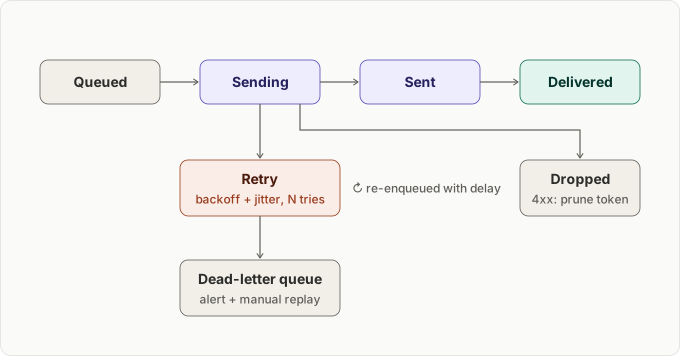
Worker decision order:
- Classify. Permanent recipient error (
UNREGISTERED,BadDeviceToken, hard bounce) → drop, prune token, never retry. Transient (429 / 5xx / timeout) → retry. - Backoff + jitter, never a tight loop. 2,000 workers retrying at the
same instant = a synchronised battering ram against your own provider —
indistinguishable from a DoS.
delay = min(cap, base × 2^attempt) × rand(0.5, 1.5), base ~1 s, cap ~5 min, N ≈ 5. Implement as re-enqueue with delay, notsleep()— a sleeping worker isn't working. - Dead-letter after N. Parking lot: unclogs the main queue, alerted on, human replay. Transactional DLQ growth pages someone; marketing = a report.
- Circuit breaker per provider — failure rate > X% → stop calling for 30 s, queue holds the backlog, probe, reopen. Paired with a shared per-provider token bucket so even the good case never exceeds the provider's rate. Queue holds the backlog; limiter shapes the drain.
- TTL — check before every attempt; expired promos drop silently.
- Fallback vendor for SMS/email (Twilio→SNS, SendGrid→SES). Impossible for push — APNs/FCM are monopolies.
Sent ≠ Delivered. Provider 200 = "accepted." Push never confirms display
(infer from app-open telemetry); SMS/email confirm later by webhook, matched
on provider_message_id. Separate states or you overstate delivery.
7. Deep dive: the five gates inside a worker
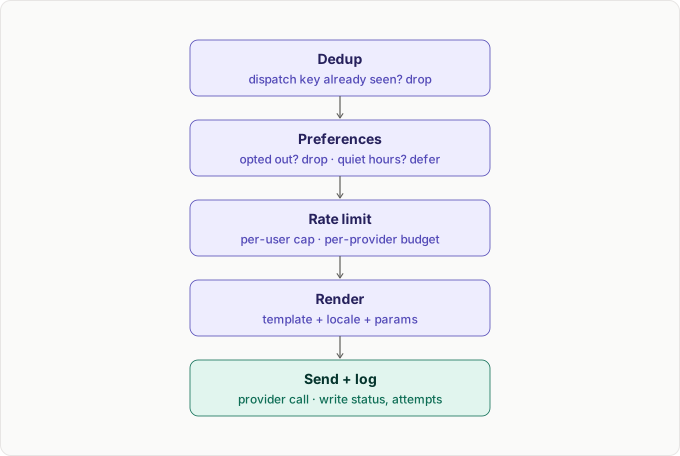
Order is deliberate: cheap rejections first, provider call last.
| Gate | What | Detail |
|---|---|---|
| 1 Dedup | SET … NX on the dispatch key | hit → ack queue msg, stop. µs |
| 2 Preferences | opted out of this type on this channel? | checked here as well as at enqueue — user may opt out while the message sits in a backlog. Quiet hours by user timezone → defer (re-enqueue with deliver_after), don't drop. Transactional exempt |
| 3 Rate limit | two different limiters | per-user frequency cap (protects the user: "≤3 marketing/day", counter per user:type:day, excess → drop or digest) · per-provider budget (protects you: shared token bucket; denied → short-delay re-enqueue) |
| 4 Render | template + locale + params → text | render late: queue payload stays tiny; a template fix applies to already-queued messages. Truncate to channel limit |
| 5 Send + log | provider call; write status, attempts, provider_message_id | then — only then — ack the queue message |
Workers are dumb by design; everything clever lives in a store they consult.
8. Deep dive: priority lanes and head-of-line blocking
Scenario: OTP enqueued 30 s after marketing dropped 10M promos into the same iOS queue → OTP arrives in 40 minutes; user hits "resend" six times; Gate 1 correctly dedups them all. Head-of-line blocking.
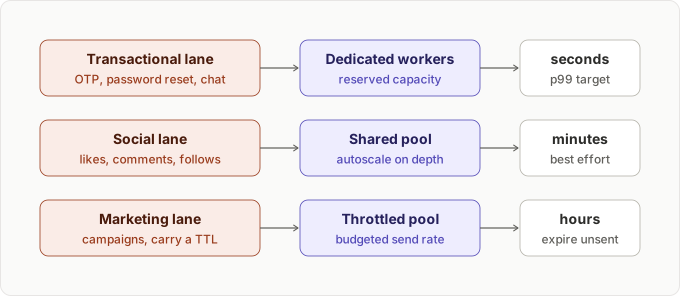
Fix = isolation by queue again, per priority class: channel × class matrix of topics.
| Lane | Contents | Pool | Target |
|---|---|---|---|
| Transactional | OTP, password reset, chat | dedicated, reserved capacity | seconds, p99 |
| Social | likes, comments, follows | shared, autoscale on depth | minutes, best effort |
| Marketing | campaigns, carry TTL | throttled to a budgeted rate (e.g. 2k/s) | hours; expire unsent |
Lanes vs one priority queue (RabbitMQ x-max-priority): a priority queue
only reorders the queue — the flood still shares the same worker pool and
the same provider token bucket, so it still starves OTPs of provider quota.
Lanes give separate pools and budgets; cost = more queues to operate. Name
both, pick lanes.
Broadcast fan-out ("send to 10M users"): the API must not resolve 10M recipients inline. Enqueue one campaign message → a fan-out worker pages the audience by cursor (~5k at a time), emits per-device messages into the marketing lane, checkpoints the cursor per page so a crash resumes at page 400 rather than re-sending page 1. Batch provider endpoints where offered (FCM v1 accepts multiple messages per request).
9. Settings, templates, analytics, security
- Settings — (user, channel, type, opt_in); cached; checked at enqueue and in the worker; transactional exempt.
- Templates — versioned per locale; message carries
template_id + versionfor deterministic late rendering. - Analytics — emit every transition (queued, sent, delivered, opened, clicked, unsubscribed). Product funnel and your best outage detector: delivered/sent for one provider dropping 98% → 60% shows before their status page does. Ops metric #1: queue depth + oldest-message age per lane.
- Security — callers authenticate (appKey / mTLS) and are rate-limited per key; provider credentials (
.p8, FCM service account) in a secrets manager, never in a payload; no PII in push payloads (Apple/Google see them in the clear) — send an ID, let the app fetch.
10. End-to-end trace (narrate it, then kill something)
  ORDER 987 SHIPPED  (transactional, push + email)
  order-svc ─► POST /v1/notifications  key=order-987-shipped  user=42
            ─► auth appKey → log insert-if-absent (new) → cache: 2 devices (ios, android), email,
               push=on, email=on → 3 rows queued → enqueue ios-txn, android-txn, email-txn
            ─► 202  (~8 ms; caller moves on)

  iOS worker     dedup SETNX ok → prefs ok → txn: no cap → provider bucket ok → render
                 → APNs 200 → log sent → ack.  Phone buzzes.

  Android worker → FCM 404 UNREGISTERED → log dropped, DELETE device row, ack.  No retry.

  Email worker   → SES 503 → log attempt=1 → re-enqueue +2 s×jitter → ack original
                 → retry → SES 200 → log sent
                 → 40 s later SES webhook "delivered" → match provider_message_id → log delivered

  KILL: iOS worker gets APNs 200, dies before mark/log/ack → queue redelivers
        mark present  → Gate 1 drops it. No duplicate.
        died in the post-ack gap → mark absent → sends again. Duplicate.  ← say it unprompted
11. Interview script
  1. clarify      channels · soft real-time · triggers (client + scheduler) · opt-out ·
                  10M / 1M / 5M per day · PRIORITY CLASSES? sent vs delivered?   ← unprompted
  2. estimate     ~160/sec avg, bursts 10³–10⁴/sec → design for bursts + third parties
  3. channels     APNs (token, HTTP/2, 4 KB) · FCM v1 (OAuth; legacy dead) · SMS/email gateways + webhooks
  4. contact info devices table, many per user, tokens rot → prune on UNREGISTERED
  5. naive        one sync server → caller latency, no retry, skyscraper, SPOF
  6. decoupled    "API accepts the job, doesn't do it" → persist + dedup → queue per channel → pool per channel
  7. reliability  persist-before-ack (+ outbox) · ambiguous timeout → idempotency key, 3 layers,
                  residual window · classify 4xx vs 5xx · backoff+jitter · DLQ · breaker + bucket · TTL
  8. gates        dedup → prefs (re-check!) → two rate limiters → late render → send+log
  9. lanes        head-of-line blocking → lanes per class, own pools + budgets, TTL; fan-out worker w/ cursor
 10. extras       settings, templates, funnel analytics, depth-based autoscaling, no PII in payload
 11. walk it      order-shipped end to end; kill the iOS worker after APNs 200 yourself
Steps 7 and 9 separate a pass from a strong pass.
12. The lines that earn the most
- "Steady load is trivial — the design exists to absorb bursts and survive third parties; that's why there's a queue between every pair of tiers."
- "The API accepts the job, it doesn't do the job — persist, enqueue, 202. Provider latency never reaches the caller."
- "An ambiguous timeout makes retrying correct and makes duplicates inevitable — so I make the second attempt harmless with a caller-supplied idempotency key derived from the logical event, checked at the boundary and again in the worker."
- "At-least-once delivery, exactly-once effect — except a crash in the window after the provider ack, which I can't close from my side."
- "Classify before you retry:
UNREGISTEREDprunes the token and never retries; 429/5xx back off with jitter; N failures dead-letter. A tight retry loop is a DoS on my own provider." - "Sent is not delivered. Push never confirms; SMS/email confirm by webhook. Separate states or I lie to the business."
- "An OTP must never sit behind a 10M-recipient campaign — lanes per class with their own pools and provider budgets; a priority queue alone still shares the quota."
- "I autoscale on queue depth and oldest-message age, not request rate."
13. Numbers to remember
| Thing | Value |
|---|---|
| Book volume | 10M push · 1M SMS · 5M email / day ≈ 160/sec avg |
| Design point | bursts 10³–10⁴/sec (campaigns) |
| Push payload | 4 KB (APNs token-based, FCM); 2 KB legacy APNs cert |
| FCM legacy shutdown | June 2024 → HTTP v1, OAuth 2.0 |
| SMS segment | 160 chars GSM-7 / 70 chars UCS-2 |
| Retry policy | exp. backoff, base ~1 s, cap ~5 min, jitter, N ≈ 5 → DLQ |
| Dedup key TTL | ≥ max retry horizon (e.g. 24 h) |
| Log retention | 90 days hot, archive beyond |
| Devices per user | ~2 |
| Fan-out page | ~5k recipients, cursor checkpointed per page |
14. Common follow-ups
| Follow-up | Answer skeleton |
|---|---|
| Duplicates | caller key + per-dispatch SETNX; name the post-ack window |
| APNs down 1 h | breaker opens, iOS lane backs up, others unaffected; TTL drops stale promos; bucket keeps the drain polite when it returns |
| 10M users in 1 hour | one campaign msg → fan-out worker, cursor checkpoints → marketing lane shaped ~3k/s → batch calls |
| Opt-out while queued | preferences re-checked in the worker (Gate 2) |
| 3 a.m. push | quiet hours by timezone → defer via delayed re-enqueue |
| "X liked your post" ×50 | collapse/digest per user per window; APNs collapse-id on device |
| In-app / web channel | add a channel: WebSocket/SSE for online users; stored inbox + unread counter (Redis ZSET per user) for offline |
| Strict per-user ordering | partition the lane by user_id (Kafka key) — ordering within a partition, none across |
| Exactly once? | not achievable end-to-end; at-least-once + idempotent effect; explain the window |
| Lost enqueue after log write | reaper on stale queued rows, or transactional outbox |
15. When NOT to go deep
Product interview ("design Instagram") → one sentence:
"Events go to a notification service — stateless API that dedups and persists, one queue per channel and priority class, per-channel workers with retries and provider rate limiting into APNs/FCM/SMS/email."
Go deep only when the notification system is the question, or the interviewer pushes on duplicates, ordering or provider outages.
16. Glossary (A–Z, one line each)
| Term | Meaning |
|---|---|
| ambiguous timeout | sender can't tell "never arrived" from "arrived, ack lost" — why retries are correct and duplicates inevitable |
| APNs | Apple Push Notification service — only path to iOS; HTTP/2, JWT (.p8) auth, 4 KB payload |
| at-least-once | every durable queue's guarantee: processed ≥1 time; duplicates possible |
| backoff + jitter | exponentially growing retry delay with randomisation so retries don't synchronise |
| circuit breaker | stop calling a failing provider for a cooling period; probe to close |
| collapse ID | provider hint: a later push replaces an earlier undelivered one on the device |
| dead-letter queue (DLQ) | parking lot for messages that exhausted retries; alerted, manually replayed |
| delivered vs sent | provider receipt confirmed vs provider accepted the request |
| device token | opaque per-app-install capability issued by APNs/FCM; stored server-side; rots |
| dispatch | one (notification, device, channel) send unit |
| fan-out worker | resolves an audience into per-device messages in cursor-checkpointed pages |
| FCM | Firebase Cloud Messaging — Android/web push; HTTP v1 API with OAuth 2.0 |
| frequency cap | per-user limit on notifications per type per window |
| head-of-line blocking | urgent message stuck behind bulk traffic in a shared queue |
| idempotency key | caller-supplied key derived from the logical event; makes retries no-ops |
| isolation by queue | give independently-failing work separate queues so it fails independently |
| notification log | durable per-dispatch status record; PK = idempotency/dispatch key |
| priority lane | separate topic + worker pool + provider budget per notification class |
| provider budget | shared token bucket capping calls per third-party gateway |
| quiet hours | user-local window in which non-urgent notifications are deferred |
| queue depth / age | primary autoscaling and alerting signals |
| reaper | background sweep that re-enqueues stale queued log rows |
| soft real-time | fast is required; bounded delay under load is acceptable |
| template | parameterised, versioned, localised body; rendered late in the worker |
| transactional outbox | write row + outbox entry atomically; relay publishes → no lost or duplicated enqueue |
| TTL | per-message expiry; dropped unsent past it |
| UNREGISTERED | FCM 404: token dead → delete device row, never retry |
| webhook | provider's async callback (delivered / bounced / complained), matched on provider message ID |