
Design a Search Autocomplete System
1. The problem
Type "tw" into a search box → before you finish, a dropdown shows 5 completions. Suggestions must appear while you type → a latency budget of tens of milliseconds, hit on nearly every keystroke by every user.
Autocomplete is two systems: a slow one that decides what the answers are, and a fast one that just looks them up.
- Query service (fast, online) — returns a precomputed answer for a prefix. Never computes top-k at request time.
- Data gathering service (slow, offline) — counts what people search, rebuilds the precomputed answers periodically.
Links to earlier notes: the news feed precomputed each user's feed; this precomputes each prefix's answer. The feed needed a celebrity fast path; this needs a trending fast path (§10).
2. Requirements (extract these)
| Question | Book's answer |
|---|---|
| Matching | beginning of query only ("tw" → "twitter", not "new tweets") |
| How many suggestions? | 5 |
| Ranking | popularity = historical query frequency |
| Spell check / autocorrect? | no |
| Language | English, lowercase alphabetic |
| Scale | 10M DAU |
Non-functional: fast (≤ ~100 ms per keystroke), relevant, sorted, scalable, highly available.
Senior questions to ask unprompted — each changes the design:
| Question | Why it matters |
|---|---|
| How fresh? | breaking news in minutes needs a streaming path (§10); weekly is far simpler |
| Personalized or global? | global = perfectly cacheable (CDN, browser); keep the shared index global, personalize on top |
| Filter harmful suggestions? | always — autocomplete puts words in front of people they didn't type |
| Languages / countries? | one index vs one per locale |
| Typo tolerance? | fuzzy matching multiplies paths explored; book scopes it out |
3. Estimation
  10M DAU × 10 searches × 20 chars (4 words × 5) → a request per character
  = 2×10⁹ requests/day ÷ 86,400 s           ≈ 24,000 QPS     peak ×2 ≈ 48,000 QPS
                                             (÷10⁵ shortcut → 20,000; same decision)
  new data: 10M × 10 × 20 B × 20% new        ≈ 0.4 GB/day
Every number ends with a decision:
- 0.4 GB/day is tiny → storage isn't the problem; don't lead with sharding.
- 24k–48k QPS in 100 ms → every request must be a memory lookup; the cheapest request is the one never sent.
- 20 requests per search is mostly waste → the client is part of the design (§7).
4. Naive version — and breaking it
SELECT query FROM frequency_table
WHERE query LIKE 'tw%' ORDER BY frequency DESC LIMIT 5;- Scans and sorts on every keystroke —
LIKE 't%'matches millions, sorted to keep 5, 48k times/sec. - Short prefixes are the most common AND the most expensive — everyone types the first letter; it matches the most rows.
- An index on
queryfinds matches but not the top 5 by frequency — still sorts the whole match set.
Fix = a prefix data structure + precompute the answer so nothing sorts at request time.
5. The trie and the optimization that matters
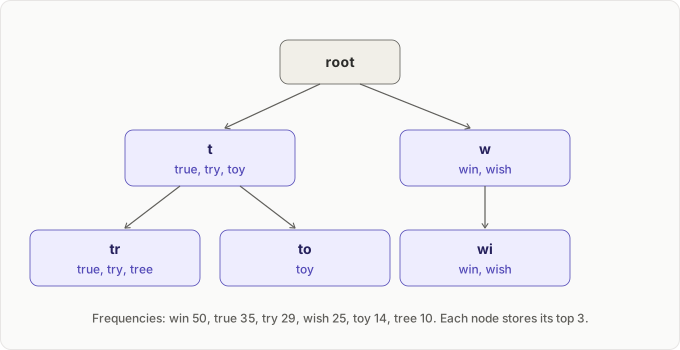
Trie = prefix tree: root is empty string, each child adds one character, a path spells a prefix; every query starting with "tw" lives under node "tw".
Naive top-k on a trie:
- walk to prefix node — O(p)
- traverse whole subtree to collect completions — O(c)
- sort, take top k — O(c log c)
Steps 2–3 are still the problem (subtree under "t" = millions).
Book's two optimizations:
| Optimization | Effect | Cost |
|---|---|---|
| Cap prefix length (people rarely type 50+ chars) | step 1: O(p) → O(1) | none worth mentioning |
| Cache top-k at every node | steps 2–3 disappear: find node, return its list | space — every node stores k queries; a popular query is duplicated in all its ancestors. Accepted: speed ≫ storage |
5.1 Senior insight: at serving time the trie collapses to a hash map
Once every node stores its answer, serving never walks an edge — hash the prefix straight to its list:
  "t"  → [true, try, toy]      "tr" → [true, try, tree]     "to" → [toy]
"w" → [win, wish] "wi" → [win, wish]- Book's two storage options: serialized trie snapshot in a document store, or KV store: prefix → node data ("prefix hash table"). KV's con: loses the parent–child relationship between levels.
- That relationship matters at build time: compute each node's top-k bottom-up by merging its children's lists — far cheaper than scanning all queries per prefix.
The trie is the build-time algorithm; prefix → top-k map is the serving format.
5.2 The "buy" option — FSTs
Elasticsearch completion suggester: in-memory finite-state transducer (compressed trie relative), per-suggestion weight for ranking, fuzzy support for typos; costly to build, held in memory, rebuilt periodically. Handles distribution, replication, failover. Mention it, then design the build-it version — the interviewer wants the mechanics.
6. High-level design
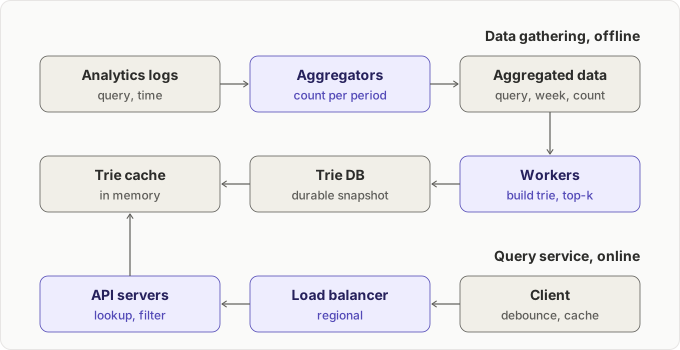
Data gathering (offline)
| Component | Role |
|---|---|
| Analytics logs | append-only (query, timestamp); not indexed. Sample (log 1 in N) at high volume — popular stays popular in a sample |
| Aggregators | roll logs into counts per period. Cadence = the freshness decision: weekly (book default for general search) vs near-real-time for social/fresh products |
| Aggregated data | (query, week_start, frequency) — the build input |
| Workers | async jobs: build the trie, compute top-k bottom-up, write to trie DB |
| Trie DB | durable snapshot (document or KV store) — what the cache reloads from |
| Trie cache | in-memory copy that serves traffic; loads each new snapshot (weekly) |
Query service (online)
Client → regional LB → stateless API server → in-memory lookup of the prefix → filters (§9) → 5 strings. Miss → read trie DB, fill cache (rare: the map usually fits in RAM, §8).
7. Making the query path fast — mostly on the client
| Technique | Detail |
|---|---|
| AJAX | fetch suggestions in the background, no page reload |
| Browser caching | Google: Cache-Control: private, max-age=3600 — private = only this user's browser, not shared proxies; 1 hour. Retyping "tw" never leaves the machine |
| Debouncing (senior) | send only after a ~100–150 ms pause; "twitter" typed fast = 1–2 requests, not 7 |
| Minimum prefix length | 1-char prefixes give generic suggestions and waste server work; start at 2 |
| Discard stale responses | responses arrive out of order — tag requests (prefix / sequence no.), drop any response not matching current input, cancel in-flight on new keystroke → dropdown never jumps backward |
| CDN / edge cache | base suggestions are global → "how to" identical for all; Zipf traffic → caching the top ~10k prefixes covers ~60% of traffic |
| Regional serving | 100 ms budget vs ~150 ms cross-continent RTT → serve near users; server lookup itself is microseconds |
8. Scaling the storage — and when not to
8.1 Do the memory math first (the most valuable senior move)
  keep ~10M distinct queries (drop the long tail), ~20 chars avg
  distinct prefixes  ≤ 10M × 20, heavily shared   → ~50M prefixes
  value              5 × ~25 B + overhead          ≈ ~150 B
  key                                              ≈ ~20 B
  total              50M × ~170 B                  ≈ ~8.5 GB → fits in one server's RAM
→ No sharding. Full copy on every serving node; replicas for throughput + availability. Read-only between rebuilds → every replica loads the same snapshot → trivially consistent; no routing, no shard map, no hot shards.
"At this scale the index fits in memory, so I replicate it fully. I shard only when it stops fitting — many languages, per-region indexes, or Google-scale vocabulary."
8.2 When it doesn't fit — book's progression
| Step | Scheme | Problem it leaves |
|---|---|---|
| 1 | shard by first character → 26 shards | need more than 26 |
| 2 | first two (aa–ag, ah–an…), then three | letters wildly uneven ("c", "s" ≫ "x", "z") |
| 3 | volume-based ranges from historical data, kept in a shard map manager (e.g. "s" alone; "u"–"z" together) | — |
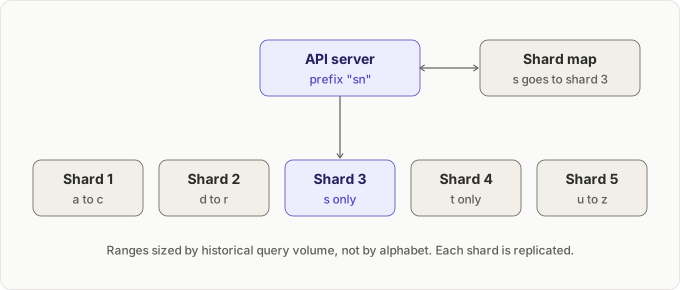
- Range vs hash: ranges keep related prefixes together and split exactly where volume is; hashing a fixed-length prefix spreads load but can't split one hot range. Volume-aware map is the book's answer.
- Rebuild the shard map with each snapshot from the same aggregated data.
- Hot shard → more replicas, not more shards (read-only scales by copying); Redis/CDN response cache absorbs the hottest prefixes.
9. Trie operations: create, update, delete
Create — workers from aggregated data (§6).
Update
| Option | Detail |
|---|---|
| Rebuild + replace weekly (default) | build offline, load alongside the old, switch in one step (blue-green, atomic); keep the old version for rollback |
| Update nodes in place | changing one query's frequency can change top-k at every ancestor ("true" → "tru", "tr", "t", root) — the price of the top-k cache. Book: only when the trie is small |
Delete — harmful suggestions must vanish now, not next week:
- Filter layer between API servers and trie cache checks a blocklist on the way out → a newly blocked phrase disappears in seconds.
- Physically removed from the index at the next rebuild.
Manipulation defense (raise unprompted) — bots searching a phrase a million times would promote it under naive counting:
- count distinct users per query, not raw searches,
- cap per-user / per-IP contribution to a count,
- minimum distinct-user threshold before a query is eligible.
10. Ranking beyond raw frequency, and trending
10.1 Time decay
Weight recent periods more: each period's count × a factor that shrinks with age → a two-year-old fad stops outranking this week. Changes aggregation only; serving untouched.
10.2 Trending — the weekly snapshot is too slow
Bar: a viral query should appear within minutes. Can't rebuild the whole index every minute → a second, small, fast path (same idea as the news feed's celebrity merge).
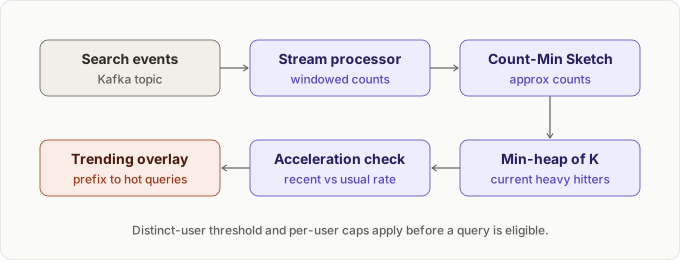
- Stream search events (Kafka) → stream processor (Flink / Spark Streaming) counts over short windows (15 min, 1 h).
- Billions of unique strings → no exact per-query counts. **Count-Min Sketch
- min-heap of size K**: sketch = approximate counts in fixed memory; heap = current top K. Sketch can overestimate, never underestimate — the safe direction for heavy hitters.
- Detect acceleration, not volume: recent rate ≫ usual rate. "weather" is always popular, not trending.
- Publish a tiny trending overlay: prefix → a few hot queries, refreshed ~every minute (only thousands trend at once).
10.3 Personalization
Per-user data inside the shared index destroys caching (every response unique). Personalize at the API layer, not in the trie. Better still: keep recent searches on the device and merge client-side → server response stays fully global and cacheable.
10.4 Request-time blending
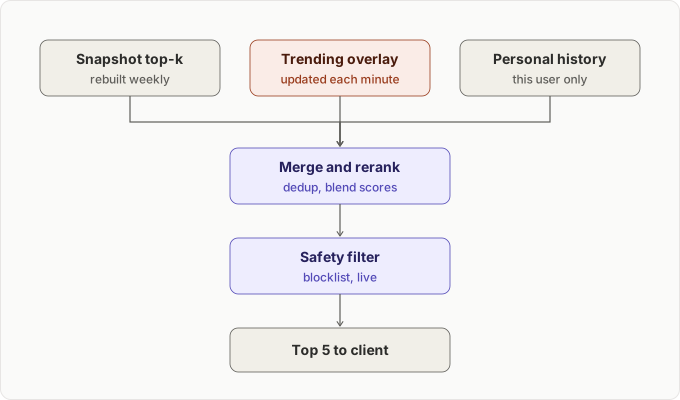
- Heavy part stays global + cacheable — snapshot + trending is the same for everyone in a region → CDN with a short TTL (~1 min) so trending stays fresh.
- Personal part small + private (or on-device).
- Filter runs last, over everything — trending is the source an attacker can push fastest; nothing bypasses the blocklist.
- ⚠️ Cache headers must follow the blend. Google's
private, max-age=3600(§7) fits a personalized response. Here the server response is global (personal merge on device) →public, max-age=60: CDN can cache it, and trending is at most a minute stale. A 1 h browser cache would freeze the overlay — and delay a blocklisted phrase leaving the dropdown by up to an hour.
10.5 Other signals / extensions
| Signal / feature | Note |
|---|---|
| Suggestion click-through | skipped suggestions are bad suggestions |
| Result quality | did the search after selecting it lead to a click? |
| Location | per-region indexes ("football": London vs Dallas) |
| Language | per-locale indexes; Unicode in trie nodes |
| Typos | fuzzy = all prefixes within an edit distance → expensive; bound it (distance 1, after 4+ chars) or spell-correct the prefix first; FSTs support fuzzy natively |
All change aggregation/build; serving stays lookup + merge.
11. Failures and consistency
Autocomplete is allowed to be slightly wrong — yesterday's list is fine, a missing suggestion is fine, the user can just type.
| Failure | Response |
|---|---|
| Serving replica dies | read-only, identical replicas → pull it from the LB |
| Weekly build fails | keep serving the old snapshot; a week staler |
| Bad new snapshot (skew, poisoned counts) | validate before swap (size, top-query sanity), instant rollback to previous |
| Streaming path behind / dead | drop the overlay; base suggestions still serve |
| Coordinated manipulation | distinct-user counting, contribution caps, live blocklist |
| Region down | route to next-nearest region; slower but working |
Degrade, never fail. Fall back to the last good snapshot; if even that is gone, the search box still works without suggestions.
12. End-to-end trace (narrate, then break)
  user types "tw"
  client   debounce 120 ms → browser cache miss → GET /autocomplete?q=tw  (request #7)
  edge     CDN miss → regional LB → API server
  server   in-memory snapshot "tw" → [twitter, twitch, twilight, twin peaks, twitch prime]
           trending overlay "tw" → breaking-news query (entered 4 min ago)
           merge + rerank → trending takes slot 3 → safety filter passes all 5
           → Cache-Control: public, max-age=60 (global response; §10.4)
  client   response is #7 and input still "tw" → render; merge 2 on-device recent searches
  submit   search appended to analytics log → sampled → stream window counts
           → this week's aggregates → next week's snapshot

  BREAK 1  "tw" pause → "twitch"; "tw" response arrives after the "twitch" request
           → stale prefix → dropped; dropdown never flickers backward
  BREAK 2  bot campaign pushes a defamatory "tw…" phrase → huge volume, few distinct users
           → never eligible; even if it were, blocklist removes it from every response in seconds
  BREAK 3  weekly build crashes → nothing visible: old snapshot serves, trending keeps it fresh,
           rerun in the morning
13. Interview script
  1. clarify      prefix-only · 5 results · frequency ranking · English · 10M DAU · <100 ms
                  FRESHNESS? PERSONALIZED? HARMFUL-SUGGESTION FILTER? locales? typos?  ← unprompted
  2. estimate     24k QPS (peak 48k) · 0.4 GB/day → storage tiny, latency + request count are the problem
  3. framing      two systems: fast lookup path, slow build path — never top-k at request time
  4. naive        LIKE + ORDER BY → scans & sorts per keystroke, worst on short prefixes
  5. trie         → cap prefix length → cache top-k per node (space + duplication)
  6. collapse     trie = build algorithm; prefix → top-k map = serving format; FST = buy option ← senior
  7. high level   logs → aggregators → aggregated → workers → trie DB → trie cache; client → LB → API
  8. client       AJAX · browser cache max-age · debounce · min prefix · drop stale · CDN · regions
  9. storage      MEMORY MATH FIRST → replicate fully if it fits; else first-char → volume shard map ← senior
 10. operations   blue-green weekly swap + rollback · in-place update costs ancestors · live filter
 11. ranking      time decay · trending stream (CMS + heap, acceleration) · personalization off-index
                  · merge at request time · filter last                                    ← senior
 12. abuse        distinct users · contribution caps · eligibility threshold              ← unprompted
 13. failures     degrade, never fail
 14. walk it      "tw" end to end, then break it three ways
Steps 6, 9, 11 and 12 separate a pass from a strong pass.
14. The lines that earn the most
- "Autocomplete is two systems: a fast path that only looks things up and a slow path that decides the answers — never compute top-k at request time."
- "Short prefixes are both the most frequent and most expensive requests, which is why the answer has to be precomputed."
- "Caching top-k at every node trades space and ancestor-update cost for O(1) lookups — and then the trie collapses to a prefix → top-k map; the trie is the build algorithm."
- "The client is part of the design: debounce, browser cache with max-age, minimum prefix length, and drop out-of-order responses."
- "I do the memory math before sharding: ~8.5 GB fits in RAM, so I replicate fully; volume-based sharding only when it doesn't fit."
- "New snapshots swap in atomically with rollback; harmful suggestions are removed by a live filter, not the next rebuild."
- "Trending is the celebrity merge of autocomplete: a small streaming overlay — Count-Min Sketch plus a heap, detecting acceleration — merged at request time."
- "Personalization stays out of the shared index so the global response stays cacheable — ideally merged on the device."
- "Count distinct users, cap per-user contribution — otherwise a bot can write your suggestions."
- "Autocomplete is allowed to be slightly wrong: degrade, never fail."
15. Numbers to remember
| Thing | Value |
|---|---|
| Book scope | 10M DAU · 10 searches/user/day · 20 chars/query · 5 suggestions |
| Requests per search | ~20 (one per character) before client optimizations |
| QPS | ~24,000 avg, ~48,000 peak |
| New data | ~0.4 GB/day (20% new queries) |
| Latency target | ≤ ~100 ms per keystroke |
| Browser cache (Google) | Cache-Control: private, max-age=3600; with a trending overlay: public, max-age=60 |
| Debounce | ~100–150 ms |
| Min prefix | ~2 characters |
| In-memory index estimate | ~50M prefixes × ~170 B ≈ ~8.5 GB |
| Hot-prefix cache | top ~10k prefixes ≈ ~60% of traffic (Zipf) |
| Rebuild cadence | weekly (book); trending overlay ~every minute |
| Trending latency target | minutes, not hours |
| Cross-continent RTT | ~150 ms → serve regionally |
16. Common follow-ups
| Follow-up | Answer skeleton |
|---|---|
| Why not just a database? | LIKE + ORDER BY scans and sorts per keystroke; worst on short, most common prefixes |
| Trie memory too big? | drop long tail; top-k per node only; KV prefix map or FST; shard only if it won't fit |
| How do you update? | weekly blue-green rebuild + rollback; in-place updates touch every ancestor |
| Remove an offensive suggestion now | live blocklist filter in front of the cache; purge at rebuild |
| Breaking news | streaming overlay: windowed counts, CMS + heap, acceleration, merged at request time |
| Personalization | API/client layer, not the shared index; on-device history |
| Typos | bounded fuzzy matching or spell-correct the prefix; FST fuzzy |
| Multiple languages / countries | per-locale indexes, Unicode nodes, regional serving + CDN |
| Hot prefixes | CDN/edge + Redis response cache; more replicas for hot shards |
| Bots gaming suggestions | distinct-user counts, contribution caps, eligibility threshold |
| Uneven shards | volume-based ranges in a shard map, rebuilt with each snapshot |
| Out-of-order responses | tag requests, drop stale, cancel in-flight |
| Mid-string matching ("tweets" for "new tw") | different problem: token/n-gram indexes — say so and scope it out |
17. When NOT to go deep
Inside a bigger question ("design Google Search" / "design a marketplace"):
"Typeahead is served from an in-memory prefix → top-k map rebuilt offline from aggregated query logs, with a streaming trending overlay merged at request time, a live blocklist filter, and client debounce plus browser caching."
Go deep only when autocomplete IS the question, or the interviewer pushes on freshness, ranking or scale.
18. Glossary (A–Z, one line each)
| Term | Meaning |
|---|---|
| acceleration | recent query rate far above its usual rate — the trending signal |
| aggregators | jobs rolling raw logs into per-period query counts |
| analytics logs | append-only (query, time) records of completed searches |
| blocklist / filter layer | live check removing harmful suggestions before they're returned |
| blue-green swap | load the new snapshot beside the old, switch atomically, keep old for rollback |
| bottom-up top-k | building each node's top-k by merging its children's lists |
browser cache (max-age) | client-side caching of suggestions per prefix (Google: 1 h, private) |
| CDN / edge cache | caching global prefix responses near users |
| completion suggester | Elasticsearch's FST-based prefix suggester with weights and fuzzy |
| Count-Min Sketch | fixed-memory approximate counter; overestimates, never underestimates |
| data gathering service | offline pipeline that builds the suggestion index |
| data sampling | logging 1 in N searches to cut cost |
| debouncing | waiting for a typing pause before sending a request |
| distinct-user counting | counting unique users per query to resist manipulation |
| FST | finite-state transducer — compressed trie-like automaton held in memory |
| fuzzy matching | matching within an edit distance to tolerate typos |
| heavy hitters | the most frequent items in a stream |
| min-heap of K | keeps the current top K by estimated count |
| personalization layer | per-user blending outside the shared index (API or device) |
| prefix → top-k map | the serving format: hash of prefix to its precomputed list |
| query service | online path: prefix in, five suggestions out |
| shard map manager | lookup service mapping volume-sized prefix ranges to shards |
| stale-response discard | client drops responses that don't match the current input |
| time decay | weighting recent counts more than old ones |
| top-k cache per node | each trie node stores its k best completions |
| trending overlay | small, minute-fresh prefix → hot-query map merged at request time |
| trie | prefix tree; one character per edge |
| trie cache / trie DB | in-memory serving copy / durable snapshot store |
| Zipf distribution | few prefixes take most traffic — why caching works |